Award winners 2025
-
Ruth Winter – Translational Radiotheranostics, German Cancer Research Center (DKFZ), Heidelberg, Germany
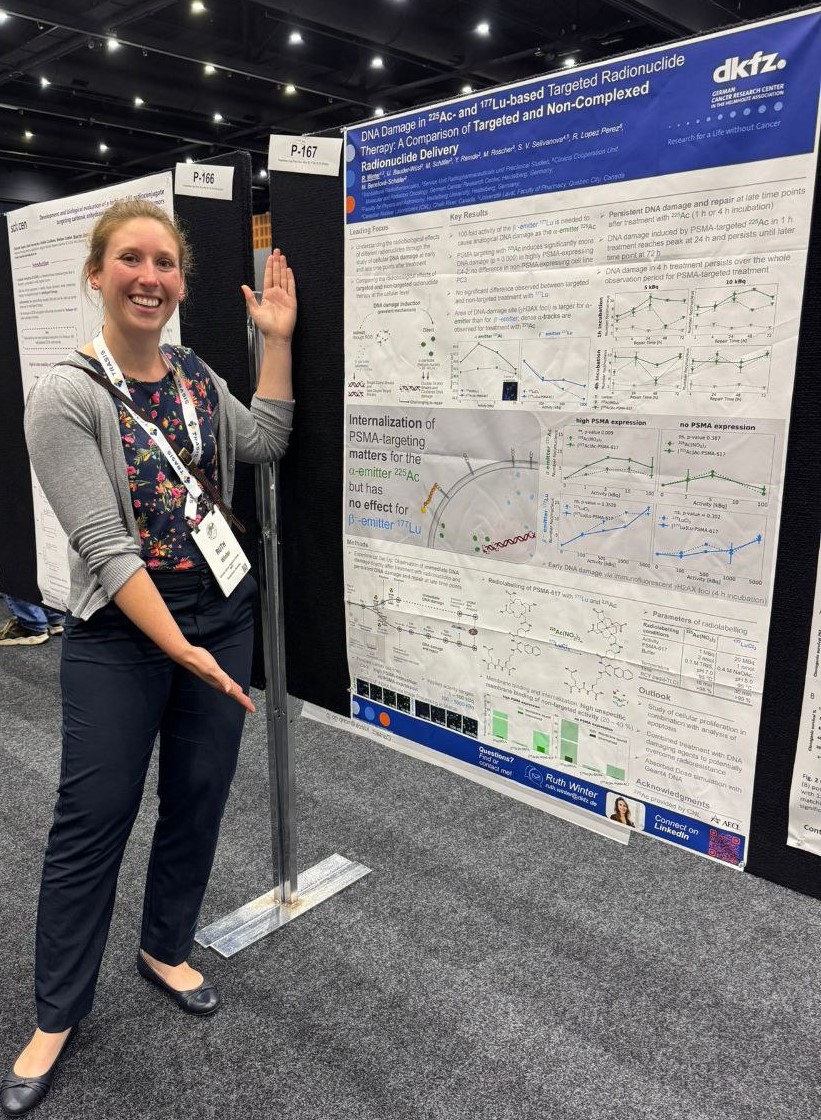
Ruth Winter at the iSRS 2025 Experience Report iSRS 2025 (International Symposium of Radiopharmaceutical Sciences): Thanks to the generous international travel award from DeGBS, I was able to attend the International Symposium of Radiopharmaceutical Sciences in Gold Coast, Queensland, Australia, from 11 to 15 May.
It was great to have the opportunity to present and discuss my research findings in front of an international audience. I was pleased to present my work during the poster presentation and I enjoyed the fruitful discussions and positive feedback. I was proud to contribute to the advancement of this field of research and the improvement of treatment options for difficult-to-treat cancer patients by interacting with colleagues, discussing results and jointly developing ideas and experimental approaches. The scientific programme was very rich and allowed me to look beyond my own field of research and expertise. During coffee and lunch breaks (and early morning surfing sessions) there were many opportunities to expand my professional network in preparation for the next step in my career as a postdoc.
Overall the conference really inspired and motivated me to pursue my career in research and academia and was a remarkable experience! -
Teresa Irianto – Translational Radiobiology, Universitätsklinikum Erlangen, Erlangen, Germany
Experience report ImmunoRad 2025: With the support of the DeGBS international travel scholarship, I had the opportunity to attend the 9th edition of ImmunoRad in Paris, co-organised by Weill Cornell Medicine and Gustave Roussy Cancer Campus. This annual conference aims to advance research and collaboration in combining radiotherapy and immunotherapy for cancer treatment. This year, ImmunoRad featured ten key sessions exploring the intersection of radiotherapy and immunotherapy across various domains, including dose and modalities, as well as preclinical, translational, and clinical research. I was particularly interested in the sessions ‘Myeloid Cells’, ‘Adaptive Immunity’ and ‘Tumour Microenvironment’, which gave me insights into the interplay and complexity of the tumour microenvironment and how this influences anti-tumour immunity. During these three days, I also had the pleasure of networking and getting to know other researchers in this research field. Additionally, I also presented a small part of my PhD project in the form of a poster with a title ‘Functional Characterisation of Irradiated Dendritic Cell Subtypes in Response to High Hydrostatic Pressure Tumour Vaccines In Vitro’, where I had the chance to discuss my research findings and get some input from researchers with various expertise from all over Europe and the US. I would like to once again express my sincere gratitude to DeGBS for their generous financial support to make my participation in ImmunoRad possible!
- Razan Hessenow – Institute of Cell Biology, University Hospital Essen, Essen, Germany
Experience report 17th International Wolfsberg Meeting on Molecular Radiation Biology/Oncology:
I would like to express my sincere gratitude to the DeGBS for generously supporting my participation in the 17th International Wolfsberg Meeting on Molecular Radiation Biology/Oncology, through the DeGBS International Travel Award 2025. This support provided me with an excellent opportunity to attend one of the most focused and high-quality international meetings in the field of molecular radiation biology.
The scientific program of the Wolfsberg Meeting was exceptionally well aligned with my research interests and current projects. The conference covered key thematic areas including DNA damage and repair, intra- and intercellular signaling, tumor microenvironment, and novel therapeutic strategies and biomarkers, all of which are directly relevant to my work in radiation biology and oncology.
One of the most interesting talks was delivered by Prof. Douglas R. Green on paradigm shifts in cell death provided important conceptual frameworks that are highly relevant for understanding radiation-induced cellular responses. The DNA repair session, including lectures on the spatial regulation of DNA repair, offered valuable mechanistic insights that closely relate to my own research focus on DNA damage response pathways and radiosensitization strategies.
In addition to attending the lectures, I presented my work as a poster during the poster sessions, which provided an excellent opportunity to discuss my research with experts in the field. The feedback and discussions during the poster sessions were highly constructive and helped refine both the interpretation and future direction of my work.
Importantly, the meeting also offered outstanding networking opportunities. Thanks to the support of DeGBS, I was able to engage in in-depth scientific discussions and establish new professional contacts, including the initiation of a potential research collaboration that emerged directly from interactions during the conference.
I am deeply grateful to DEGBS for their generosity and for providing me with the opportunity to participate in this outstanding international meeting through the DeGBS International Travel Award 2025.